Fixing Europe’s air traffic system:
A path towards one unified sky
Marc Baumgartner
Centre supervisor and air traffic controller at Skyguide, AAE

Pierre Andribet
Former R&D manager at Eurocontrol, AAE
Jean-Marc Garot
Former director of Eurocontrol
experimental centre, AAE
For years, experts and officials in the European Union have warned that air traffic management in Europe is too fragmented and inefficient. Commissioner Loyola de Palacio had already pointed this out back in 2000, noting that, while safety levels were high, Europe’s patchwork of national systems caused delays and wasted resources. Reports from the European Court of Auditors and other EU bodies have repeatedly confirmed this imbalance.
Attempts to reform the system have stalled as individual countries have resisted giving up national control. Then came the Covid-19 crisis, which engendered a €8.6 billion shortfall and forced many governments to financially rescue their air navigation providers. Now that flight traffic is almost back to normal, there is a risk that European air traffic management (ATM) will slip back into its old habits, leaving inefficiencies and environmental challenges unresolved.
Three major changes are needed to build a better European ATM system: strengthen the role of the Network Manager, modernise the infrastructure that supports air traffic management, and organise data and services in smarter, more centralised ways.
Giving more power to the Network Manager
The Network Manager (NM) is the EU body which helps coordinate airspace use and flight flows across the continent. Right now, its power is limited – it can advise and monitor but not really enforce a unified plan.
The aim is to give the NM authority over three critical aspects:
European airspace design and management
Airspace optimisation is key to meeting Single European Sky and Green Deal objectives. Long-identified bottlenecks remain unresolved due to states’ reluctance to delegate control. A stronger NM should be empowered to define optimal airspace structures, require states to justify deviations, finalise the deployment of FRA concept (Free Route Airspace), and arbitrate disputes.
Pan-European responsibility for Air Traffic Flow and Capacity Management (ATFCM)
A reinforced NM will coordinate capacity and demand both strategically and tactically. This would include the ability to delegate congested airspace to underused neighbours, oversee air traffic controller staffing, and make real-time adjustments similar to the US Air Traffic Control System Command Centre (ATCSCC).
Responsibility for overall network efficiency
Beyond delay reduction, the NM will pursue a holistic optimisation of cost and environmental performance.
Modernising Communication, Navigation and Surveillance (CNS)
Europe’s technical systems for guidance and communication – known as CNS – are still managed separately by each country’s air navigation provider. This is costly and slows innovation. The solution is to treat CNS like a shared service purchased from specialised providers instead of something every country builds and maintains alone.
This approach already works elsewhere. The US Federal Aviation Administration (FAA) uses private companies such as Aireon and Inmarsat for global satellite tracking and communication services. A similar model in Europe will reduce duplication, lower costs, and speed up the adoption of new technologies like next-generation satellite-based communications.
A European-level infrastructure manager will coordinate these services with the Network Manager, ensuring that future upgrades align with overall traffic needs. The main challenge would be to prevent monopolies and address concerns over national control, but with careful oversight, the benefits far outweigh the risks.
Building a smarter digital system for air traffic
Thanks to faster networks and powerful servers, it is now possible to create a digital, more centralised air traffic management system. Instead of each country running its own proprietary systems, a common platform could host shared “ATM data services”.
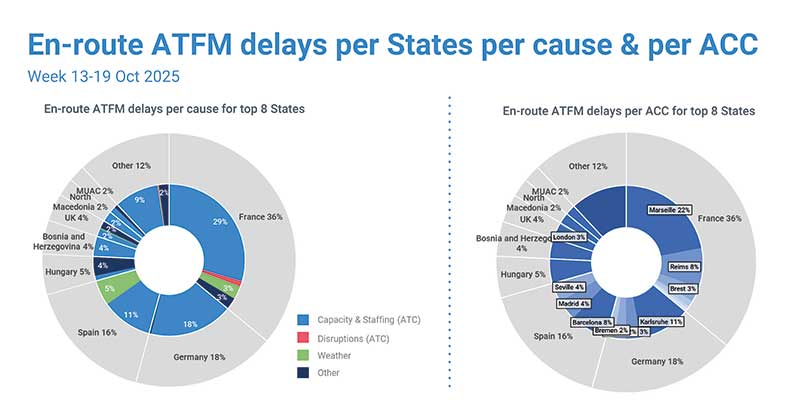
En-route ATFM delays by state, by cause and by centre. © Eurocontrol
Under this model, control centres would keep local controller positions but connect to centralised servers managed by certified data service providers. These providers would handle:
- surveillance data, combining radar and satellite information for a complete picture of air traffic in Europe;
- flight plan data, ensuring a unique flight plan instead of different incoherent versions;
- aeronautical and weather data, giving all users the same accurate and up-to-date information.
This would cut costs dramatically and make operations more flexible and resilient. If one part of the network faced technical problems, others could quickly take over.
Cybersecurity would also improve under one coordinated system instead of many scattered ones.
With this kind of setup, air traffic controllers, airports and airlines could share the same real-time information. That means faster decisions and safer skies. Coordinating air and ground systems would also help reduce delays and emissions through better planning.
Leveraging AI for Next-Generation ATM
A shared data system would open the door to using artificial intelligence (AI) throughout European aviation. AI could predict bottlenecks, suggest better flight paths, detect safety risks, and even automate routine tasks. In the long term, AI might enable semi-autonomous air traffic operations in low-traffic areas, improving both safety and efficiency.

Le Centre des opérations du gestionnaire de réseau à Eurocontrol. Photo © Eurocontrol
Managing stakeholder resistance
While the technical roadmap is clear, it demands more than common sense and requires strong, sustained political with strategic incentives.
The difficulties are manageable (see box). Our proposals offer the optimal technical goal.
Progress may not mean full, immediate adoption of all elements but, based on a firm political push at the European level and supported by financial compensation, a realistic roadmap will pave the way toward the truly integrated sky Europe needs.
| Stakeholder group | Core resistance/position | Strategy for change |
| Air Navigation Service Providers (ANSPs) | Fear of revenue/job losses. As the primary beneficiaries of the current fragmentation they resist rationalisation attempts, fearing job reductions and a loss of autonomy. | Economic compensation & negotiation. A firm political stance must be shown, coupled with negotiations. A new revenue allocation system based on contracts for service provision must incentivise changes. It represents opportunities for ANSPs. |
| Member states | Sovereignty argument. States, often driven by their ANSPs, invoke national sovereignty and military control over airspace. | The Maastricht centre demonstrates that sovereignty concerns can be managed to benefit all stakeholders. The dramatic financial strain due to the Covid-19 crisis should be an eye opener for states to accept organisational change. |
| Airlines | Generally supportive, but silenced. Airlines strongly advocate for rationalisation to reduce costs and improve performance. However, those recently receiving heavy state subsidies may be reluctant to openly criticise governments. | Harness the pressure. The prospect of significant route charge increases can make airlines more prone to call for reform. The benefit needs to be demonstrated. |
Article originally published in Newsletter No 140