Dossier 58: Towards an essential European air shield

Claude ROCHE
President of the AAE working group on the European air shield(1)
Other members of the working group: Gérard Brachet, Jean-Georges Brévot, Philippe Charruyer, Bertrand de Montluc, Jean-Daniel Testé
Followingan in-depth study of the impact of the war in Ukraine on the characteristics of different military cultures and the state of the armed forces in Russia and Europe, whilst also taking into account the lessons learnt from conflicts in the Middle East, AAE presents in this dossier n°58 the results of its analysis focusing on:
- the organisation of European forces and the strategy to be adopted, taking into account the differences in military culture between Europeans and Russians;
- the real threats that are emerging;
- the measures to be implemented in the short and medium term.
One of the key findings of the report concerns the profound differences between European and Russian military cultures. Russia continues to favour a highly centralised model, in which decisions are taken at the top of the hierarchy and implemented with limited autonomy at lower levels. This approach makes it possible to mobilise large numbers of troops and equipment, but at the cost of some operational rigidity.
Conversely, European armed forces rely more on the delegation of responsibilities, local initiative and rapid adaptation to circumstances. This ability to make decisions at all levels constitutes a major strategic advantage that must be reinforced through a broad use of digital technologies and artificial intelligence. Decision-support tools, derived from operational research, could significantly speed up the analysis of situations and conduct of operations.
However, Europe is still made up of states with different military traditions, organisations and equipment, and coordinating them remains a complex task requiring further effort. The work already underway within NATO provides a solid foundation, but it will need to be taken further in order to establish a genuine European air and missile defence architecture.
The dossier then identifies several key capabilities required to ensure the continent’s security. The first is information superiority. In modern conflicts, the ability to detect, identify and track threats before the adversary is crucial. This requires the development of intelligence, surveillance and electronic warfare capabilities capable not only of providing an accurate picture of the situation, but also of disrupting enemy systems.
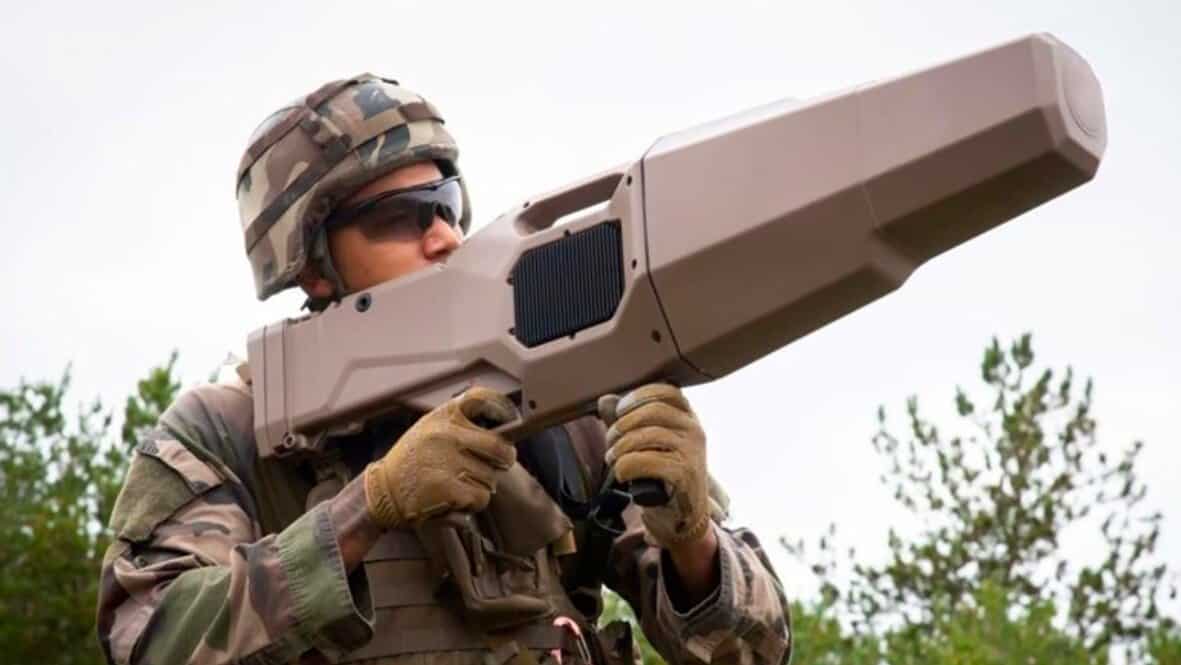
Training with the NEROD jammer – © Julien Fechter/armée de l’Air et de l’Espace/Défense, 2023
Countering drones also appears to be an immediate priority. The experience in Ukraine shows that these systems, which are often inexpensive, can overwhelm traditional defences. In light of this development, Europe must develop effective detection capabilities, mass-produce anti-drone drones and prioritise solutions that are simple, quick to manufacture and economically viable. The ability to adapt continuously will be essential in a field where technologies are evolving at a very rapid pace.
Protection against cruise missiles is another pillar of the future European air shield. AAE recommends strengthening medium-range surface-to-air defences whilst significantly increasing the number of combat aircraft available. These remain, in fact, the most flexible means of intercepting massive, simultaneous attacks across vast territories. A substantial increase in stocks of air-to-air and surface-to-air missiles is also deemed essential.
The threat posed by ballistic missiles, meanwhile, requires a specific approach. Europe already has effective systems at its disposal in terms of tactical missiles, whose production must be stepped up. However, there must be more investment in protection against longer-range missiles, particularly in the areas of early warning, detection and the coordination of interception capabilities.
Satellites now play a vital role in intelligence, secure communications, navigation and early warning. Europe must therefore strengthen its space capabilities, develop more satellite constellations and accelerate programmes to ensure its autonomy in this critical field.
Finally, AAE emphasises that the success of a European air defence system will depend largely on its command system. The various sensors, effectors and decision-making centres will need to be linked within a common architecture capable of operating in real time on a continental scale. Artificial intelligence will play an increasingly important role in this, assisting military staff in analysing data and conducting operations.
In conclusion, Europe possesses the technological, industrial and human capabilities required to ensure its defence. However, in the face of rapidly evolving threats, it must now accelerate its integration, strengthen its production capacity and invest without delay in the technologies that will form the foundation of its future security. Dossier 58 sets out recommendations along these lines for decision-makers.
Other posts in News :