From space to startups: How Europe is transforming its defence industrial base

Timo PESONEN
Director General for Defence Industry and Space (DEFIS), European Commission
Europe’s security environment has changed profoundly over the past decade. Strategic competition, technological disruption and high-intensity conflict on our continent underlined the need for a strong, innovative and competitive European defence industrial ecosystem. The White Paper for European Defence – Readiness 2030 sets a clear direction, backed by a concrete roadmap.
To deliver, the EU has built a chain of instruments: the European Defence Fund (EDF) has supported collaborative defence R&D since 2021 (over EUR 7 billion for 2021–2027); the European Defence Industry Programme (EDIP) strengthens industrial readiness and cooperation; and Security Action for Europe (SAFE) provides up to EUR 150 billion in loans to support Member States’ defence investments. In parallel, the proposed EUR 90 billion Ukraine Support Loan aims to underpin Ukraine’s resilience, including by supporting defence industrial capacities. Together, these instruments reinforce Europe’s ability to design, produce and sustain critical capabilities, reduce strategic dependencies, and bring innovation to market faster. They also help shift from fragmented demand towards more coherent European cooperation, including where joint development and procurement can accelerate delivery. The Defence Industry Transformation Roadmap puts it plainly: shorten innovation-to-deployment cycles, scale industrial capacity, and harden supply chains for critical components.
The rise of “new defence”: faster, smarter, and highly connected to the battlefield
Traditional major defence programmes were designed to deliver complex capabilities that remain in service for decades, with long development cycles and substantial funding. This model remains essential. Yet the pace of technological change and the evolution of threats also require complementary approaches. This is the context for what is often referred to as “New Defence”: more agile, iterative and digitally driven innovation, with faster feedback loops between users and developers.
Artificial intelligence, cyber capabilities and drones are shaping modern warfare. These technologies evolve in months rather than years and are often driven by civilian and dual‑use ecosystems. Recognising this reality, the EDF supports disruptive technologies and experimentation, while the EU Defence Innovation Scheme (EUDIS) helps connect start‑ups, research centres and established industry with military users, enabling earlier testing and faster transition towards operational use. EUDIS activities, including defence innovation challenges and hackathons focused on real operational problems, are part of this cultural shift: from risk‑averse procurement towards controlled experimentation and learning.
Recent and ongoing conflicts underline the relevance of this approach. The war in Ukraine has shown how battlefield conditions accelerate adaptation, particularly in areas such as drones, electronic warfare and operations in GNSS‑denied environments. Rapid prototyping, modular design and close cooperation between users and developers have proved decisive. We therefore increasingly prioritise user‑driven innovation, field testing and scalable architectures – building a defence ecosystem that can learn at the pace of operational realities.
Ukraine is also helping Europe to structure this innovation‑to‑scale pipeline. BraveTech EU connects EU innovation support with Ukraine’s rapid iteration ecosystem, helping solutions move from development to testing and early deployment. EDIP’s Ukraine Support Instrument provides a framework to support Ukraine’s defence industry and deepen its integration with Europe’s industrial base. We also established the EU Defence Innovation Office in Kyiv as a connector to Ukrainian testing loops and European scale-up, alongside BraveTech EU.
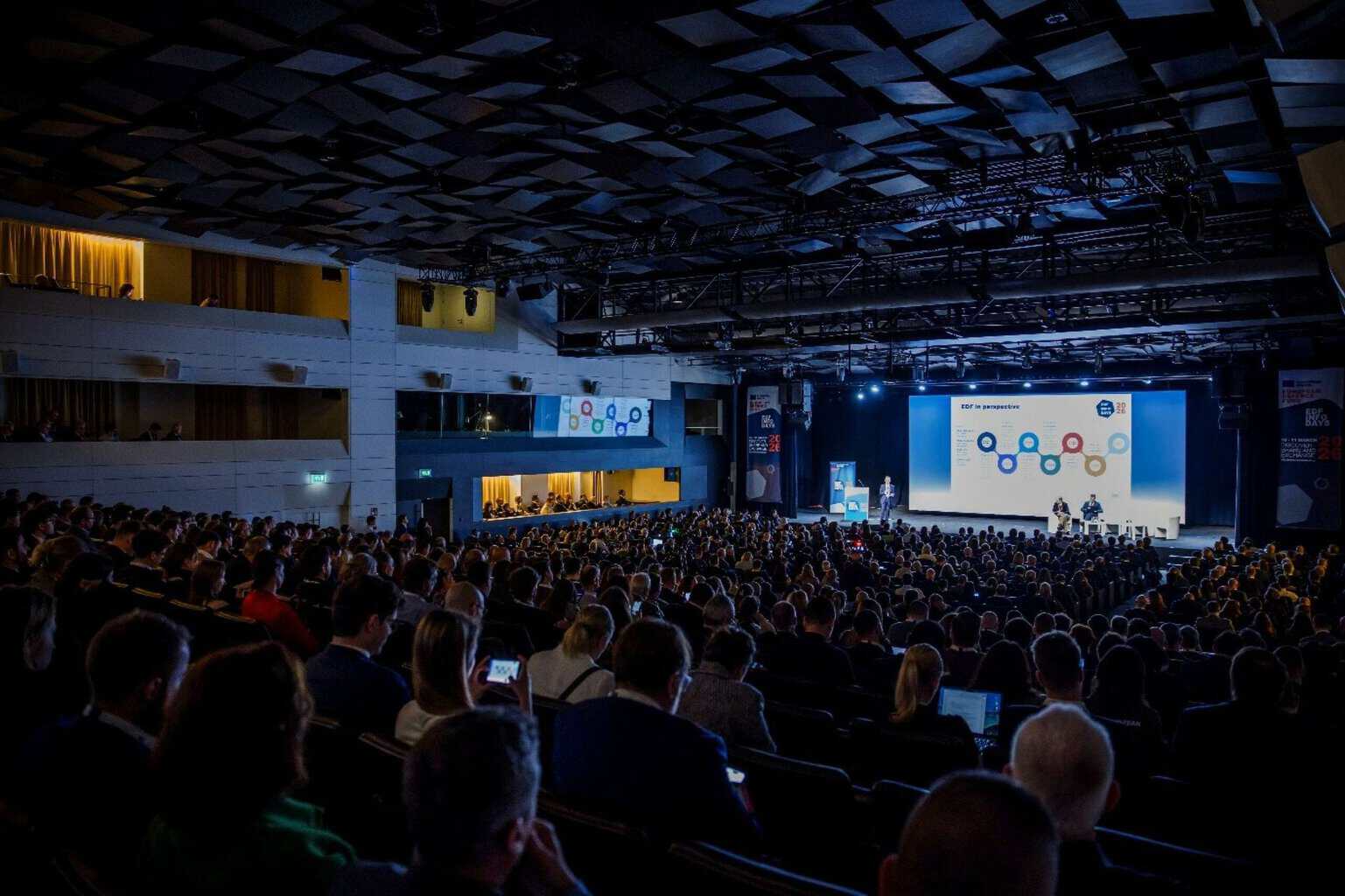
Plus de 5 200 participants se sont réunis à l’occasion des FED Info Days 2026. / Over 5200 participants gathered for the EDF Info Days 2026. Photo © Europa.eu
Expanding the defence ecosystem: a combined top-down and bottom-up approach
The transformation of Europe’s defence industrial base relies on a deliberate combination of bottom‑up innovation and top‑down strategic investment. This reflects a simple logic: technological edge requires an ecosystem where agile innovation and long‑term capability development reinforce each other.
On the bottom‑up side, initiatives such as EDF/EUDIS lower barriers to entry in defence markets that have traditionally been dominated by large prime contractors. Accelerators, matchmaking and collaborative EDF projects help start‑ups and SMEs understand defence requirements, scale technologies and connect directly with users. In addition, the “Defence mini‑omnibus” has introduced simplified and fast‑track procedures for innovative technologies, reducing administrative burden and speeding up implementation.
At the same time, Europe continues to rely on strong top‑down investments in strategic areas that underpin long‑term resilience. Key capability priorities for Readiness 2030 include air and missile defence and drone and counter‑drone systems. Space is also central: secure satellite navigation, Earth observation and protected communications are indispensable for modern operations, building on Galileo, Copernicus and GOVSATCOM. Europe must also ensure the protection and resilience of its space assets and services against growing threats, including through space domain awareness and protection against jamming and spoofing. A European “space shield”, focused on resilience, protection and assured service continuity, helps protect critical infrastructures and sustain high‑value industrial capacities.
The interaction between these two dimensions creates mutual benefits. Major programmes provide direction and stability, while start‑ups and deep‑tech firms can deliver rapid innovation and disruptive solutions. Together, this combined top‑down and bottom‑up approach is reshaping a stronger, more innovative and more resilient European defence industrial ecosystem.
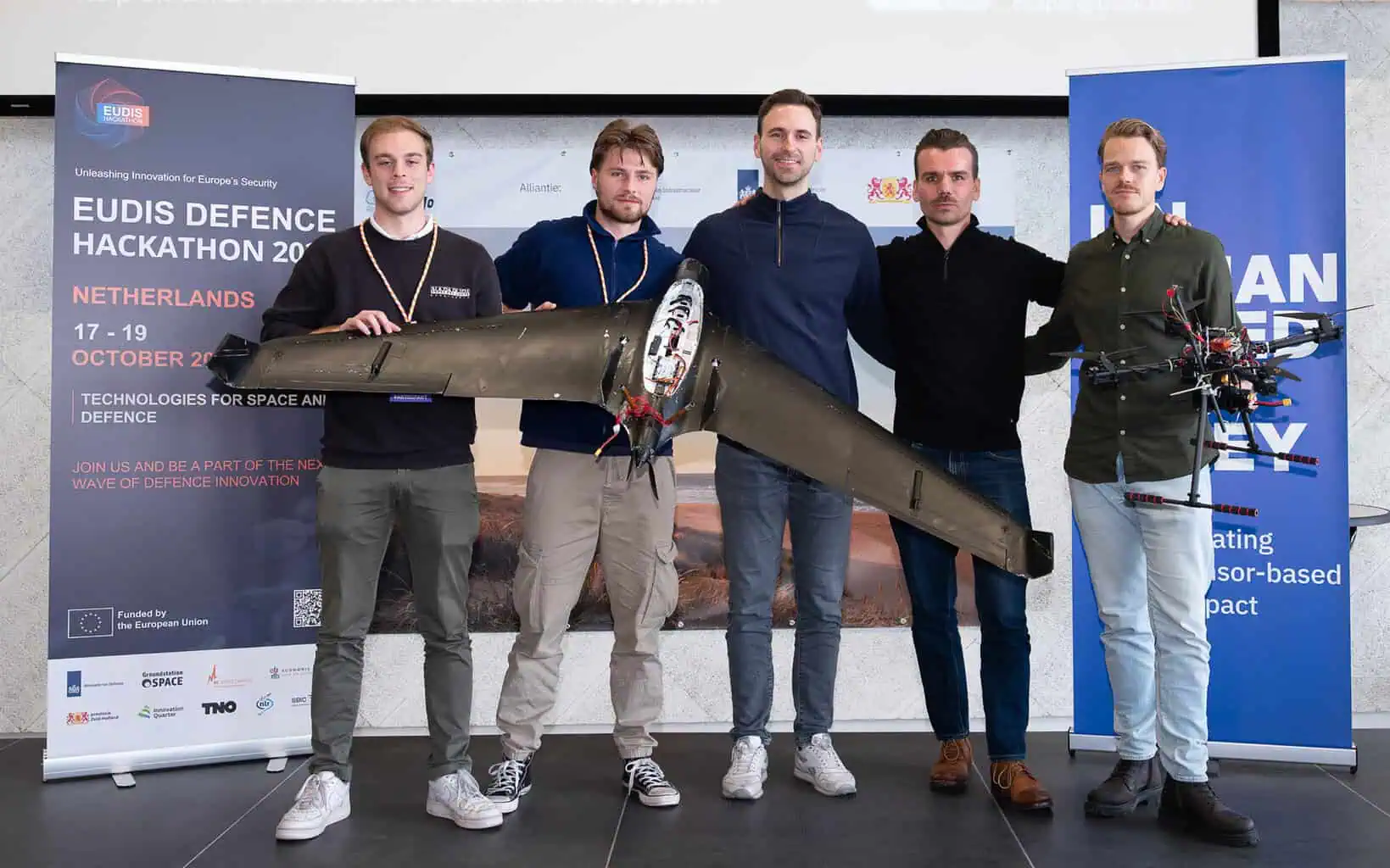
Trusk Tech, Pays-Bas, gagnants du « hackathon 2025 » organisé par EUDIS, dans la catégorie Aérospatiale souveraine. / Trusk Tech, The Netherlands, winners of the EUDIS 2025 hackathon, category Sovereign Aerospace. Photo © Monica Stuurop fotografie and EUDIS (EU Defence Innovation Scheme)
Conclusion : a collective transformation towards Readiness 2030
This transformation is not only about funding. It requires governance that rewards speed and delivery, closer cooperation between Member States armed forces, industry and academia and sustained political commitment. The Defence Readiness Roadmap 2030 and the Transformation Roadmap set milestones towards a Europe capable of anticipating threats, mobilising innovation and sustaining long‑term industrial capacity. For Europe, the test is delivery: shorter cycles, trusted supply chains, and the ability to scale manufacturing when needed. By aligning industrial policy, innovation support and strategic planning – from space systems to AI labs, from primes to start‑ups, Europe is laying the foundations of a defence ecosystem that is faster, more resilient and more competitive, while remaining anchored in cooperation and interoperability across Europe.
Other posts in News :