Tomorrow’s skies: Europe’s path to clean, competitive aviation
Sébastien DUBOIS
Head of Unit, Programme Development & Communications, Clean Aviation
Taking off, flying, gliding – an early engineering dream has come true. Doing so with very little or no emissions in the atmosphere: that’s what countless engineers are working on right now.
The aviation sector is a crucial factor for Europe’s competitiveness, supporting 15 million jobs in the EU, and with European companies holding 58% market share of new civil aircraft. The sector enables economic growth both by connecting regions and by stimulating innovation in key technology areas. At the same time, it is also hard to lessen its imprint: 95% of emissions are generated by commercial flights currently largely dependent on fossil fuels or Sustainable Aviation Fuels (SAF) since low-carbon alternatives like electric or hydrogen power are not yet viable for short, medium and long range aircraft. Hydrogen, hybrid-electric or full-electric aircraft aim to fill this gap – this provides opportunities to new entrants in the market, but also to competitors outside Europe. Breakthroughs will only be possible with substantial investment in Research & Innovation, along with public support to help new champions emerge in Europe and to preserve its competitive edge in certain market segments.
SAF – part of the solution, but not a panacea
SAF will account for more than half of the CO2 reductions needed to achieve carbon neutrality – provided it will be available and reasonably priced. With its Sustainable Transport Investment Plan, the European Commission has taken steps to help accelerate funding and production of renewable and low-carbon fuels, both for use in the aviation and the maritime sectors. If we look closer at the different levers to reduce the environmental impact of flying, SAF certainly is part of the solution, but not a panacea. It is in combination with more efficient aircraft based on low-carbon technologies that it can unfold its full potential – and this type of aircraft will also be needed to preserve the competitiveness of the sector in the context of higher fuel costs. This new generation of aircraft is expected to enter the market in the next decade and deliver no less than a 30% improvement in performance.
Let’s first consider the undeniable advantages of SAF. To start with, refuelling is as smooth and quick as it is now – only the way in which the fuel is produced changes. Liquid hydrogen, by contrast, would require a full transformation of existing infrastructure; likewise, batteries, while needing fewer adaptations, offer limited scalability due to the low energy density of current technologies. However, adapting the whole aviation system to the usage of new energy sources will demand significant investments: for SAF, to scale up production at an affordable price; for battery-powered aircraft, to install charging stations at airports; for liquid hydrogen, to get access to green electricity to produce hydrogen in sufficient quantities to supply airports.
Also keep in mind that the ecological consequences of aviation are not limited to carbon dioxide emissions. Non-CO2 effects, such as emissions of nitric oxides (NO) and nitrogen dioxides (NO2) – NOx for short – must be taken into consideration, alongside contrails. Although SAF outperforms kerosene with regards to contrails due to its lower aromatic and sulphur content (which results in fewer soot particles and ice crystals forming when combusted), the non-CO2 effects remain present and are only partially mitigated. A full electric aircraft powered by batteries or fuel cells, on the other hand, completely eliminates NOx emissions. In terms of contrails, the outcome is less clear-cut: battery technologies do not generate contrails; liquid hydrogen in combination with fuel cells seems to be a promising approach to control them, but when it comes to H2 combustion, the contrails risk is not to be neglected.
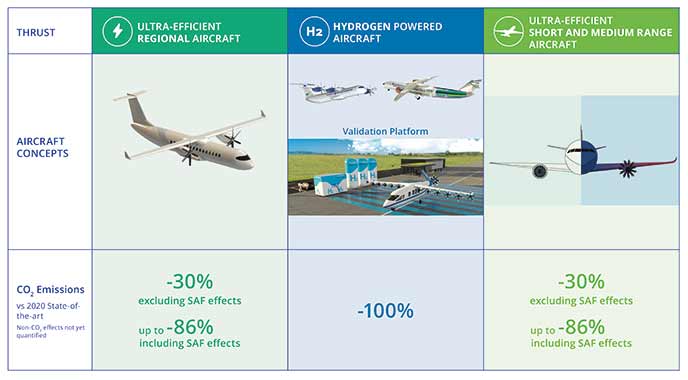
Target performance levels across the aircraft categories selected for demonstration in Clean Aviation. Photo © Clean Aviation
The need for more efficient and alternative aircraft technologies
The cost of SAF is another major obstacle: while both hydrogen and electric energy are cheaper than synthetic fuels, SAF today is three to ten times more expensive than conventional aviation fuel. Even in future, SAF is expected to remain twice as expensive as today’s kerosene, according to the European Aviation Safety Agency. The higher costs will affect the prices of blended SAF based on Biojet, synthetic SAF or kerosene, which are required under the ReFuel-EU Regulation – and this does not even take into account future price fluctuations for fossil fuels or CO2 taxes for air travel.
Considering that in aviation, fuel costs generally account for one third of an airline’s total operating expenses, highly efficient aircraft is therefore vital to preserve competitiveness. Completely changing propulsion energy sources is another path, and only advanced and disruptive technologies can achieve this.
Our mission at Clean Aviation is to transform aviation towards a sustainable and climate-neutral future, with a strong and competitive European aviation sector. The approach proposed in our Strategic Research and Innovation Agenda (SRIA) comprises a research effort of at least €4.1 billion, supported by an EU funding level of €1.7 billion, complemented by at least €2.4 billion of in-kind contributions from Clean Aviation JU’s private-side members.
As the EU’s leading research and innovation programme in the field, our projects aim to integrate and demonstrate disruptive aircraft technological innovations to decrease net emissions of greenhouse gases by no less than 30% compared to 2020 state-of-the-art technology, with the aim to support the launch of new aircraft entering into service by 2035 to achieve carbon neutrality by 2050:
- Ultra-efficient Regional (REG) aircraft architectures – driving research into novel hybrid electrical power architectures and their integration; and maturing technologies towards the demonstration of novel configurations, on-board energy concepts and flight control, and efficiency improvements for a next regional aircraft accommodating between 50 and 100 passengers. This effort will include a hybrid turboprop equipped with a 2035 state-of-the-art thermal engine coupled to an electric motor/generator, with batteries providing electrical energy. Flight test demonstrations are foreseen by 2030.
- Ultra-efficient Short and Medium-Range (SMR) aircraft architectures – addressing the short to medium range needs with innovative aircraft architectures, making use of highly integrated, ultraefficient thermal propulsion systems and providing step-change improvements in efficiency. Two propulsion system architectures (open fan or ducted) are under consideration for this aircraft concept and they need to reach high Technology Readiness Levels (up to TRL6) by 2030, including industrial aspects, to support an entry-into-service by 2035. Also for the SMR, specifically the open fan architecture, we plan for flight test demonstrations to take place by 2030.
- Hydrogen-Powered Aircraft (HPA) architectures – enabling aircraft and engines to exploit the potential of hydrogen as a non-drop-in alternative zero-carbon fuel, in particular liquid hydrogen. The specific constraints and opportunities of hydrogen technologies might lead to new classes of aircraft, with their own specific capabilities, besides the current Regional and SMR market segmentation. As stated earlier, both fuel cells and H2 direct combustion are options for this type of technology, which is foreseen to enter the market from 2040 onwards.
With respect to CO2 emissions, HPA architectures would completely avoid them, whereas both REG and SMR aircraft architectures promise a 30% reduction compared to 2020 state-of-the-art aircraft – which, when combined with 100% SAF, can be as high as 86%.
What can we infer from this? The engineering dream to fly has become a reality, and the dream to fly sustainably can become one as well. This will not only benefit the environment: innovation propelled by sustainable aviation goals will drive the aviation sector’s competitiveness in future. In view of the negotiations on the EU long-term budget, close to 100 European stakeholders have drawn up ARIS, the Aviation Research and Innovation Strategy, which was handed over to European Transport Commissioner Apostolos Tzitzikostas in June 2025. ARIS insists on the importance of investment in Research & Innovation and Market Uptake, with strong alignment of national and European efforts. According to ARIS estimates, €66 billion are needed to support the launch of new products and to preserve our innovation capabilities.
Europe has brilliant minds working on breakthrough technical solutions in aviation, at universities, research centres, in SMEs and the industry. What they need now is the right backing. With targeted, long-term commitment, Europe can secure its leadership in aviation – and turn today’s ideas into tomorrow’s solutions.
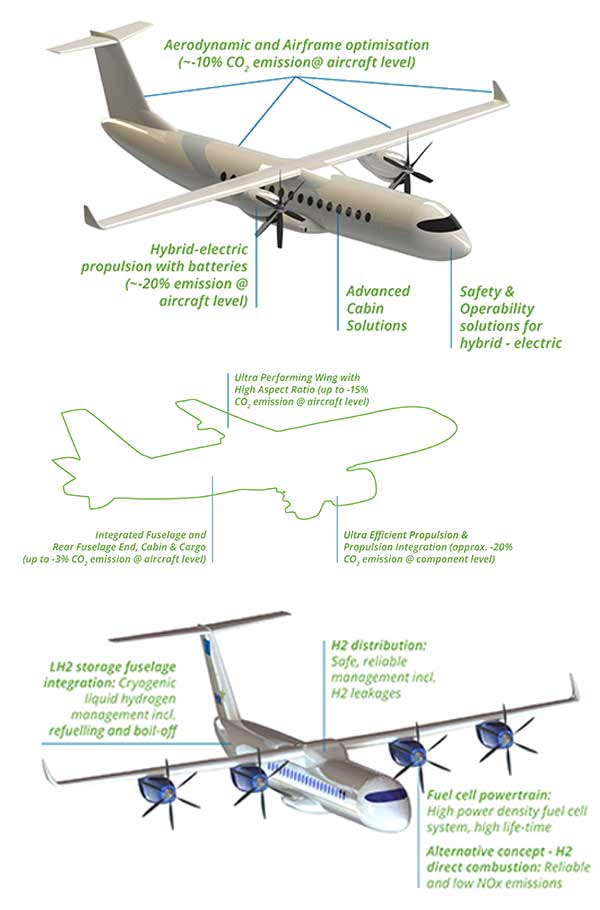
Various aircraft concepts under study: ultra-efficient regional aircraft, ultra-efficient short- and medium-haul aircraft, hydrogen-powered aircraft. Clean Aviation
Article originally published in Newsletter No 140
Academy publications (available as books or free PDFs)

Dossier 55 – Decarbonising air transport by 2050: a question of energy
AAE Dossier n°55 develops the themes already addressed in its Opinion n°20. It analyses the situation of air transport in a predominantly international context, discusses credible technical progress in aviation over the coming decades, lists the various solutions for obtaining CO2-neutral fuels, and details the considerable challenge facing society to produce sufficient decarbonised energy for aviation and other uses.
In areas where there is still a great deal of uncertainty, it sets out the issues and outlines possible solutions.
Finally, from a viewpoint of sobriety, it looks at the possibilities and limits of moderating traffic growth in the more developed countries.
Opinion N°20: Decarbonising air transport
Air transport is global: it has enabled an incredible expansion in relations between peoples. It intends to be sustainable in the face of the climate challenge and is aiming for carbon neutrality by 2050.
In addition to the technological levers outlined in this opinion, the decarbonization of air transport, like that of all economic activities, will require considerable resources in decarbonized electricity, sufficient CO2 capture and sequestration capacities, and an air transport policy that encourages sobriety, accepted at both individual, collective and international levels.
The result of two years' work by the Energy and Environment Commission (C2E), comprising more than 60 members from eight European countries with collective expertise in the fields of climate, energy and aeronautics, Opinion No. 20 turns the spotlight on the ways and means of decarbonising air transport, in particular on reducing consumption but also on the considerable energy requirements.
Dossier 55, which is more extensive, will detail the reflections that led to this Opinion.
Other posts in News :