• Space debris: sustainability of operations

    by Christophe Bonnal, Senior expert, launchers Directorate at CNES, chairman of the Commission debris of the IAA, correspondent of the EFA The massive development of space applications that we are witnessing is confronted by a number of constraints, among which the pollution of space appears to be one of the most significant. The unbridled use […]

  • History of wind tunnels, future of measurements

    Aeronautics, Automotive, building, sport,... all of these sectors have in common the use of aerodynamic wind tunnels for their studies and research. For more than a hundred years, French industry has been designing and optimizing its achievements thanks to the internationally recognised aerodynamic means that are available in France; The ONERA, CSTB and the S2A3 […]

  • Stratobus, self-contained stratospheric platform

    by Jean-Philippe Chessel, Director of the Stratobus product line, Thales Alenia Space A helium-inflated stratospheric airship powered by photovoltaic cells, storing its energy in a regenerative fuel cell system, ensures a very long-term mission. The needs are multiple: terrestrial or maritime surveillance, telecommunications in difficult areas or in addition to terrestrial and satellite networks for […]

  • Artificial intelligence, the present and the possible future

    by Claude Roche, former director of programme at the DGA, former vice-president major systems of Matra Défense Espace, vice-president of the EFA This conference shows and explains in detail the evolution and actual content of the research and applications of artificial intelligence since its beginnings, then its current developments, and how and why they allowed […]

  • The exploration of the giant gas planets: Saturn and Jupiter

    This conference will take place in two parts. The great discoveries of the US-European mission Cassini-Huygens, which explored Saturn and its procession of satellites for 13 years (2004-2017), then preparations for the European mission juice, developing for the exploration of satellites of Jupiter and its satellites Galilean from 2030 – launch programmed in 2022-will be […]

  • Can Europe win the Moon?

    Conference organized by: In partnership with Free admission. Booking recommended on the Website of the Cité de l'espace  

  • Gaia Mission: keys to the Milky Way

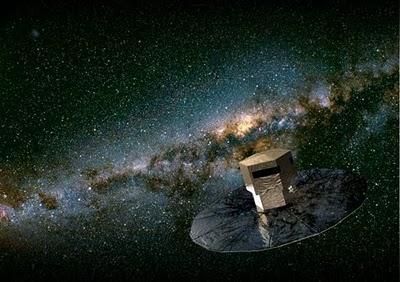
    By François Mignard, research director emeritus CNRS, member of the Bureau des longitudes On April 25, 2018, ESA and the European consortium DPAC delivered the second version of the results produced by Gaia satellite observations. By the diversity of data, their volume and especially the extreme precision of astrometry and photometry, it is an important date in […]

  • Airports of the Future

    By Marc Noyelle, former deputy CEO of Aeroports de Paris and president of ADPI, Member of AAE. Most "Airports of the Future” (by 2060) will actually be today's 500 largest airports, strongly adapted to support growth (tripling of the number of passengers) and to offer better services. Fewer than 100 new airports will be built, mainly […]

  • In search of life on the habitable exoplanets

    by Jean-Loup Bertaux, Director of Research emeritus at the CNRS at the Laboratoire LATMOS, associated with the Université de Versailles Saint-Quentin, member of the Academy of Air and space. Are we alone in the universe ? This question was until now in the realm of speculation and science fiction. With the revolution of exoplanets, she […]

  • New ideas about dark matter

    Lecture presented by Françoise COMBES, French Académie des Sciences, Bureau des longitudes, College de France, Observatoire de Paris The problem of missing mass in the universe, on a scale of galaxies, of large structures, and especially of overall content, is a multi-faceted enigma. Since 1985, we know that this matter is non-baryonic and does not […]

  • Entretiens de Toulouse 2019 (Toulouse Encounters)

    The principle This training course is organised around thematic encounters spread over 4 half-days. The participant chooses: 4 half-day encounters from the 14 areas of discussion and 56 interviews proposed and builds their "customised" training course over 2 days. Each encounter brings together up to 30 people. One or more recognised experts present the topic […]