European satellite navigation programs: EGNOS and Galileo

Raymond ROSSO
Former Galileo interministerial coordinator at the French Ministry of Ecology, Sustainable Development and Energy, AAE member
Radio navigation has used radio signals to locate moving objects since the early 20th century. With the advent of satellites, this coverage has become global. The American GPS system, which has been operational since 1993, dominates this technology yet it remains under military control. This raises sovereignty issues for Europe, which is why it has developed its own complementary systems: EGNOS and Galileo.
EGNOS: European augmentation system
EGNOS (European Geostationary Navigation Overlay Service) is a satellite-based GPS augmentation system that complies with the SBAS standard of the International Civil Aviation Organization (ICAO). Launched in 2011, it aims to improve the accuracy, reliability and integrity of GPS signals, particularly for critical applications such as aviation.
Operating with three geostationary satellites and a network of around 40 ground stations, EGNOS:
- corrects errors caused by the ionosphere;
- provides an immediate alert in the event of a signal anomaly;
- improves accuracy to approximately one metre horizontally and two metres vertically, compared to five to ten metres for GPS alone.
Initially designed for civil aviation, EGNOS enables precision approaches equivalent to those of traditional systems such as the Instrument Landing System (ILS), without the need for costly ground infrastructure (see Figure 1). According to a European Commission regulation (IR PBN) it will become the primary landing system in Europe after 2030. It will also be essential for the management of future drone traffic in dedicated airspace (U-Space).
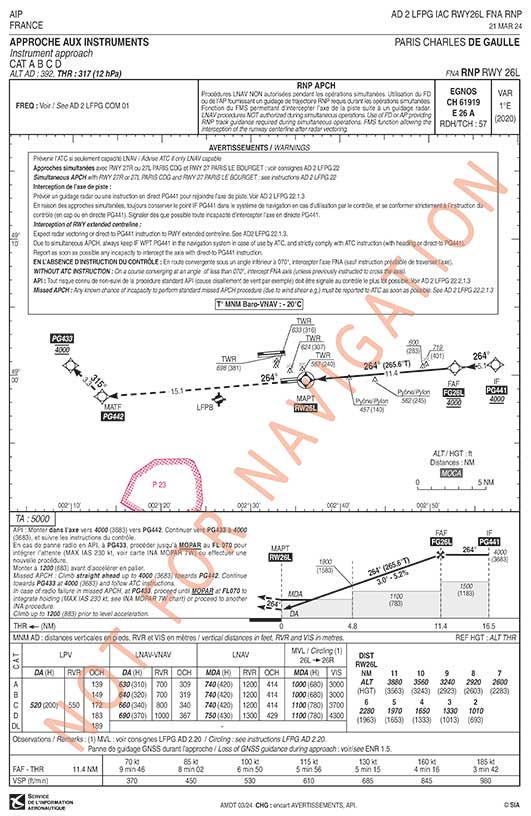
Example of an EGNOS-guided final approach procedure at Paris-CDG. © DSNA
The project was launched in the 1990s by CNES and ONERA, then developed by ESA and transferred to the European Union (EU). Today, EUSPA (the EU Agency for the Space Programme) manages EGNOS, supported by ESA and industrial partners: Thales Alenia Space for the current version and Airbus Defence & Space for the next. ESSP (European Satellite Services Provider), based in Toulouse and Madrid, provides the service to users. Its shareholders are the main European air navigation service providers.
The new version of the EGNOS system will further improve performance by supporting GPS and Galileo signals in dual-frequency mode. It will also enable the service to be provided using only the Galileo constellation, if necessary.
Galileo: independent satellite navigation system
Galileo est le système global de navigation par satellite conçu par l’UE pour garantir son indépendance stratégique face aux systèmes étrangers. Il offre une précision et une fiabilité supérieures, avec une constellation de satellites en orbite moyenne à 23 222 km.
Although Galileo is interoperable with other systems, it is also completely autonomous and aims to ensure the continuity of services that are critical to Europe’s security, economy and sovereignty.

Galileo satellite constellation. ESA – P. Carril
The system comprises three segments:
- space: a constellation of 30 satellites (24 operational and six in orbit reserve) across three orbital planes. 27 satellites were already active in October 2025 with two Ariane 6 launches planned for December 2025 and 2026;
- ground: two control centres (in Germany and Italy) and stations for telemetry and remote control, satellite data transmission and signal monitoring and listening for search and rescue (SAR) services, as well as two safety management centres (GSMCs) in France and Spain;
- users: user receptors.
The Galileo services that can be used by civil aviation are:
- the Open Service (OS): free, with ICAO recently adopting signal authentication (OSNMA) to combat cyber-attacks through spoofing;
- the Search and Rescue (SAR) service: part of the Cospas-Sarsat network, it quickly locates distress signals and informs the emergency services;
- High-Precision Services (HAS) and Emergency Warning and Support Services (EWSS) intended for applications outside the aeronautical field; the encrypted Public Regulated Service (PRS) is reserved for public authorities and security forces.
Galileo signals are broadcast in several frequency bands, some of which are reserved for aeronautical use to ensure a high level of safety. Civil aircraft will be able to use these signals provided they are equipped with a DFMC (Dual Frequency Multi Constellation) receiver that complies with the ICAO standard.
The Galileo system is operated by EUSPA under the supervision of the European Commission, which has funded the programme in full since 2008. ESA is responsible for the technical design.
Conclusion
EGNOS and Galileo are the two complementary pillars of the European space strategy for satellite navigation. EGNOS improves the reliability of GPS (and Galileo) in sensitive sectors such as civil aviation, while Galileo provides Europe with an independent and sovereign global positioning capability.
Article originally published in Newsletter No 140