Danger of interactions between uncoordinated automated systems
Luc Deneufchâtel
Working group coordinator, AAE member
AAE has recently published Opinion No. 21, which highlights the growing risks associated with the parallel and often uncoordinated development of safety automation in ground-based air traffic control (ATC) systems and aircraft-based systems. This Opinion aims to alert institutional and industrial stakeholders in the air transport sector, including ICAO, EASA, Eurocontrol, FAA and SESAR JU, to the need for an integrated approach to designing, operating and regulating these automated systems in order to maintain and improve the overall safety of air transport. To this end, the Opinion makes seven key recommendations and calls for the urgent establishment of a global cooperative framework to ensure consistency, standardisation and mutual trust between airborne and ground-based automated systems — a prerequisite for a safer and more efficient airspace.
General context
Civil aviation continues to enhance safety while responding to growing traffic and environmental requirements. Although developments in ground and airborne systems follow a similar logic of integrating feedback and technological upgrades, they are often carried out independently. This technical and organisational compartmentalisation can create inconsistencies between automated systems designed with the same goal in mind: to prevent collisions, runway incursions and collisions with terrain (CFIT).
The shift towards more strategic air traffic management, embodied by the European SESAR programme, further emphasises the need for interoperability between systems.
Problematic interactions between automated systems
Preventing in-flight collisions: ACAS vs STCA
The introduction of ACAS/TCAS (Airborne Collision Avoidance System) on board aircraft and STCA (Short-Term Conflict Alert) on the ground has improved the detection of trajectory conflicts. However, these systems operate independently of each other. For example, ACAS, which is fully autonomous, may instruct a vertical manoeuvre, while the controller, alerted by STCA, may simultaneously issue a conflicting instruction.
The Überlingen accident in 2002 dramatically illustrated this lack of coordination. Since then, human procedures have been implemented, but technical synchronisation remains limited. The Opinion recommends automating resolution advisories (RA) via datalink to reduce the “blind period” between an RA being triggered and the controller being informed.
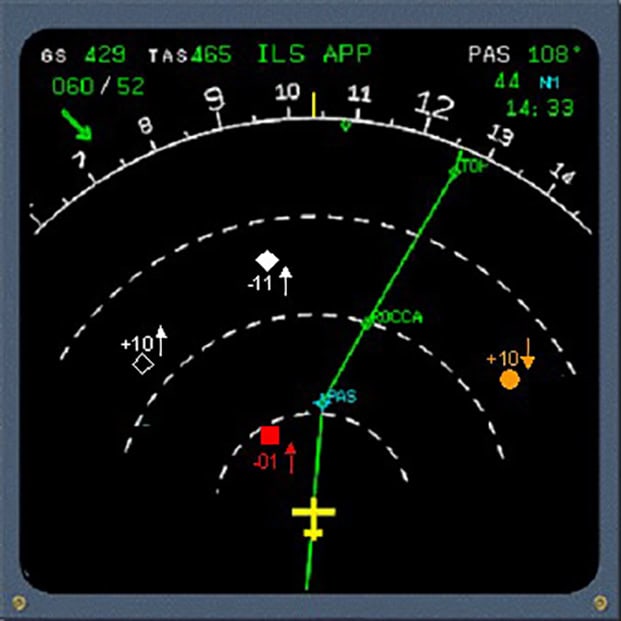
TCAS integrated in Navigation Display.© CC

Terrain Awareness Warning System (TAWS).
Preventing controlled flight into terrain: TAWS vs MSAW
Although both systems aim to prevent CFITs, they are based on separate databases and logic. While their actions rarely contradict each other, inconsistencies between them can cause confusion. MSAW (Minimum Safe Altitude Warning), which is not standardised and unevenly deployed, is less reliable than TAWS (Terrain Avoidance and Warning System). To harmonise their operational use, a joint analysis of TAWS/MSAW alerts is recommended.
Airport security: non-harmonised ground and airside measures
Runway incursions continue to pose a significant threat. Systems such as the Advanced Surface Movement Guidance and Control System (A-SMGCS) and Runway Status Lights (RWSL), as well as clearance compliance control modules, enhance surveillance on the ground. On the aircraft side, tools such as AMMs (Airport Moving Maps) and future ADS-B based (Airborne Dependent Surveillance mode Broadcast) onboard networks improve situational awareness.
However, these innovations are not coordinated: ground systems use multiple sensors (both cooperative and non-cooperative), while airborne systems rely solely on ADS-B signals. This asymmetry can lead to conflicting alerts and inappropriate responses.
SESAR programme and current limitations
Launched in 2007, the SESAR programme aims to modernise European air traffic management, based on the concept of optimised 4D trajectories. While it has enabled numerous technical advances, SESAR has yet to define a cross-functional operational concept to coordinate ground, airborne and airport operators. Cooperative decision-making (ATM-CDM), which is essential to the coherence of the overall system, is still lacking. This shortcoming could slow down the transition to a more automated and integrated ATM system.
Key recommendations
AAE makes the following seven recommendations:
- Mandate EASA to define an overall operational concept that specifies the roles and interactions of all stakeholders (air traffic control, operators, manufacturers and authorities).
- Standardise and validate any new ground or airborne device to ensure the absence of uncontrolled interactions.
- Regulate the sharing of ATM data between stakeholders as a prerequisite for cooperative decision-making.
- ntegrate the new concepts into the training of engineers, controllers and pilots.
- Generalise the automation of ACAS RA execution to reduce latency and the risk of human error.
- Deploy an automatic datalink to inform the controller when an RA has been executed.
- Standardise STCA globally to harmonise its performance and responsiveness.
Article originally published in Newsletter No 140