AI in aerospace: outlook, risks, challenges
Guy TARDIEU
Former president of OSAC, member of the AAE
For a good ten years now, as in all sectors, players in the aviation and space industries have begun to venture into the field of AI, sometimes without even realising it.
To put it simply, AI is an increasingly “intelligent” combination of ever more powerful computing capabilities, high-performance algorithms, access to a multitude of databases and, above all, a form of integrated and cross-disciplinary learning.
That said, AI is not a homogenous “religion”. It takes many forms and encompasses – or will encompass – a multitude of projects developed by experts in collaboration with the managers who will be responsible for supervising the eventual products of such projects.
In the aeronautics industry, the first tools designed to streamline aircraft design and engineering activities, as well as certain software programmes for flight tracking or the management of emergency situations, already constituted an early form of AI. Since then, things have accelerated rapidly. AI has made its way into virtually every field related to aviation and space, and we are far from the end of this process.
In the industrial sector, players in the aerospace industry will continue to see the use of AI expand into almost every area: design, certification, industrialisation, monitoring of products in service as well as future product development. Whilst gains are to be expected in terms of efficiency and cost savings, such changes nevertheless present risks.
The omnipresent nature of AI will profoundly transform the landscape of professions and industrial processes. The roll-out of design support tools will have an impact on the role of engineers and their teams, and the same can be said of tools to support the transition to production. These upheavals will need to be anticipated and managed. Indeed, various AI tools will themselves be available to map out these necessary changes and support their implementation.
As Arthur Mensch, founder and managing director of Mistral AI, recently pointed out, “providing engineers with the right tools to automate certain tasks and improve design is the future of the sector”.
There will, however, be risks involved in allowing AI to become so pervasive without a minimum level of supervision and accountability on the part of decision-makers. During the design and industrialisation phases, giving AI a completely free rein might lead to strategic errors, economic dead-ends, or even a decline in previously achieved safety standards. This aspect needs to be formalised and regulated.
Furthermore, whilst we must not underestimate the significant role AI can play in the development of industrial, commercial or marketing strategies, the ultimate responsibility for the running of businesses lies with their management teams.
In the field of operations, the most common example of what AI can achieve is that of predictive maintenance processes. The resulting cost savings from reduced downtime are undeniable. The aim now is to extend this approach to maintenance across all aircraft systems.
However, these are essentially decision-making aids. Ultimately, it is the maintenance manager who decides whether or not to replace the component in question. Whilst the impact is likely to be less severe than in the industrial sector, changes to processes and organisation will nevertheless be required and must be approved by regulators.
In air operations, AI also makes a significant contribution. Since long-haul flights operate at higher altitudes and over longer durations, AI can provide valuable real-time assistance to pilots and operations control centres in anticipating critical situations and how they may develop.
Some airlines use AI tools to better manage individual pilot fatigue, enhancing flight safety. Other applications enable airlines’ operational departments to develop contingency plans or strategies for managing chaotic situations. But here too, the focus is on decision support. Ultimately, managers will have to decide which options to pursue “with full knowledge of the facts”.
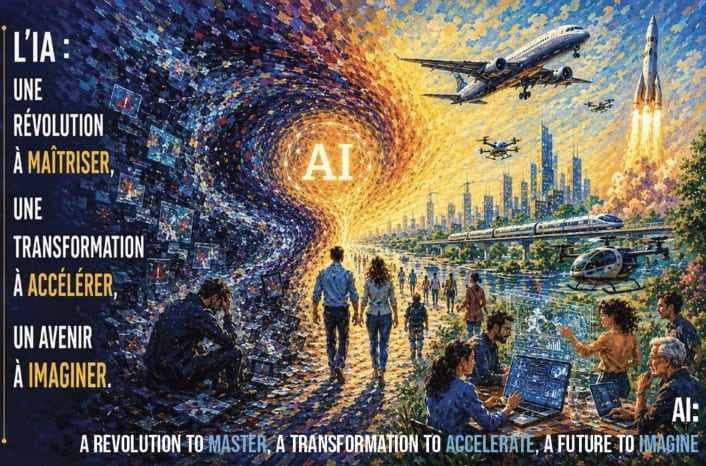
In all these areas, AI could become a vital tool for identifying slight pointers to vulnerabilities in processes and organisations, whilst strengthening the options available to decision-makers.
Another question warrants consideration: how will the regulatory framework and associated oversight evolve? The new regulatory measures introduced by EASA over the past decade have led to compliance monitoring processes which can now only be carried out effectively with the support of AI and its ability to cross-reference a multitude of parameters. This applies both to operators subject to oversight and to the authorities carrying out that oversight. This represents a paradigm shift which is only just beginning to be embraced, but which will constitute a major step forward for flight safety.
In the space sector, simulation, learning and risk management are particularly important, underpinning current ambitions for space exploration and exploitation.
In the military sphere, drone operations can only be conducted effectively with the help of AI: the Ukrainian army demonstrates this every day. AI has already had positive results in supporting the conduct of operations, in terms of cost savings, consistency in decision-making and improved performance.
AI can therefore be said to have found its way into every aspect of our fields of activity. And yet each of us must ensure that we do not allow it to make critical decisions without first analysing the risks and responsibilities involved. One key concept prevails: accountability. Throughout the entire chain, we must be able to answer a simple question: who is responsible for what? It will never be AI.
It is also worth noting that heated debates are still raging in the laboratories at the forefront of AI development. Current systems perform remarkably well when processing sequences of symbols — language, code or mathematics — but the ambition now is to fully apply AI to the real world, which is infinitely more complex.
As Yann LeCun pointed out, “the history of AI is a succession of high hopes and slightly over-optimistic claims, followed by the realisation that the problem is more complicated than we think”. This point serves as a reminder of the need for a balanced perspective. AI is a powerful tool, but it must not be confused with human intelligence, which is capable of intuition, judgement and responsibility.
No matter how far into the future we look, no AI, however advanced, will ever be capable of making the decision taken by Captain Chesley Sullenberger on 15 January 2009 to land flight US1549 on the River Hudson. However, it can help to rapidly draw up several relevant scenarios and present them to the decision-maker.
This is probably where its true value lies: in enhancing human capabilities rather than replacing them. or the aviation and space sectors, the challenge is therefore not to choose between humans and machines, but to organise their complementary aspects in the interests of safety, performance and innovation.