Impact of AI on careers and corporate strategies

Patrick PEUREUX
Former VP Innovation, Air France industries, AAE correspondent
Impact on careers
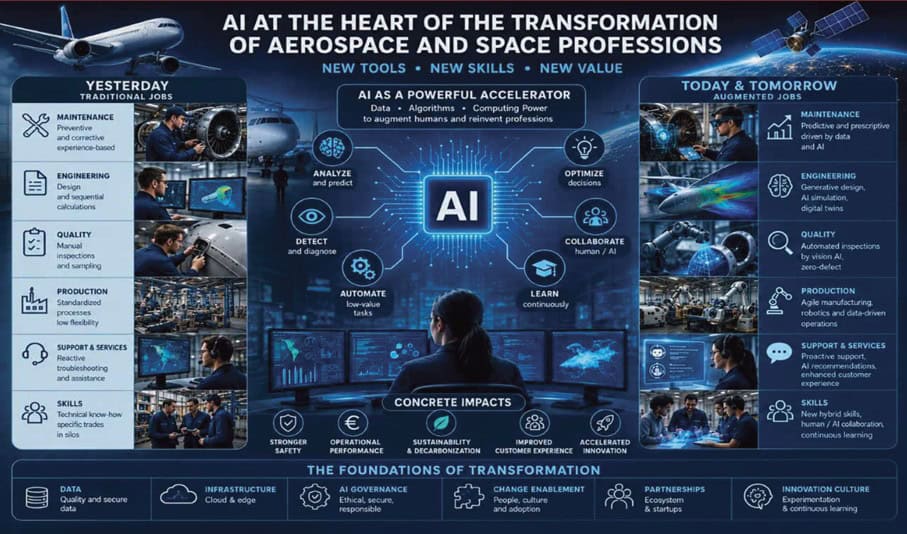
In the short term (2025–2027): transformation of tasks
The shift is already underway. AI is not leading to mass job losses, but it is changing the way we work. Certain tasks – the most repetitive or standardised ones – are being taken over by AI, but human expertise remains essential for strategic decision-making and the validation of outcomes.
The aerospace jobs most affected in the short term are:
- Quality control and inspection: computer vision algorithms are used to detect defects in parts and structures. Companies such as Dassault Systèmes are developing predictive maintenance tools: sensors combined with AI to anticipate breakdowns and reduce production stops. Air France KLM Engineering & Maintenance has done the same for aircraft, as has Rolls-Royce for engines.
- Technical documentation and reports: automated generation of reports, flight reports and maintenance summaries reduces the administrative workload for technicians and engineers.
- Air traffic management: air traffic controllers are seeing their decision-support tools become increasingly sophisticated, with AI capable of anticipating conflicts between flight paths.
- Pilots and co-pilots: automated incident detection systems and predictive failure models are gradually changing the role of the pilot, who is increasingly becoming a supervisor of intelligent systems.
- Satellite operators: with on-board AI, ground crews see some of their operational decisions delegated to the satellite itself, with human staff reassigned to a monitoring role.
In the medium term (2027–2032): a fundamental restructuring of business lines
The labour market is gradually dividing into three groups: highly skilled roles that combine professional expertise with a command of AI; highly people-centred roles – such as those involving care, interpersonal relationships or frontline work – which are difficult to automate; and roles based solely on the processing of standardised information, which are in decline.
Occupations in sharp decline: Robotics and AI could lead to the loss or transformation of 14 to 20 % of jobs in the aerospace industry by 2030, primarily affecting repetitive, dangerous or physically demanding roles. Examples include airport security staff, warehouse staff and non-destructive testing operators on standardised production lines.
Fast-growing sectors: The rise of green aviation and digitalisation is leading to the creation of new roles such as hydrogen propulsion engineer, aviation cybersecurity expert and AI-assisted predictive maintenance specialist. More broadly speaking, the professions in highest demand include machine learning engineers, data scientists, prompt engineers, AI ethicists, and human-machine coordinators, who optimise collaboration between employees and AI tools.
In the space sector specifically, experts anticipate the emergence of specialists in sector-specific language models for space, capable of consolidating systems engineering requirements across the entire industry.
What is becoming increasingly valuable across all professions: skills that machines cannot easily replicate or fail to master: critical thinking, creativity, emotional intelligence and decision-making. The challenge is no longer about production, but about managing and challenging the machine.
Strategies to be developed
AI governance: plan the structure before deployment
There is an alarming gap between intentions and reality: 90% of employees use AI for personal purposes (‘Shadow AI’), but only 40 per cent of companies have officially rolled out an in-house solution, and only 5% of AI projects integrated into business processes are considered truly effective.
The priority, therefore, is to move away from ‘Shadow AI’ and establish clear governance: a code of practice, an ethical framework, the identification of eligible processes, and the management of proprietary data. The EU AI Act, which comes into force in 2026, imposes strict rules, particularly regarding the recruitment or assessment of employees, with penalties of up to €35 million or 7% of global turnover.
Upskilling & Reskilling: training as a strategic investment
Reskilling (training for new roles) and upskilling (developing skills in emerging technologies) programmes are becoming increasingly common. Internal mobility is encouraged to retain talent and offer employees opportunities for career progression within the organisation.
Upskilling and reskilling are no longer merely training initiatives: they are drivers of HR performance, business performance and social responsibility. In the context of the CSRD, they become strategic pillars with a dual impact: operational performance and ESG compliance.
Ecosystem partnerships
Partnerships between industry, higher education institutions and training organisations are essential for anticipating future skills needs and adapting study programmes to the realities of the market. For those in the space and aerospace sectors, this also means collaborating with deep-tech start-ups and agencies (CNES, ESA, EASA) to jointly develop frameworks for critical AI skills.
Technological sovereignty and data
The National Space Strategy 2025–2040 identifies the technologies that are critical to sovereignty and scientific excellence, requiring a European convergence of business models in order to collectively defend strategic autonomy in space. Companies must therefore develop their own AI models or capabilities based on proprietary data, rather than relying entirely on third-party platforms.
Managing human and cultural change
The adoption of AI will only be successful if it is managed as a genuine HR project focused on human and cultural transformation. HR must offer tailored pathways, such as intergenerational communities and reverse mentoring programmes, to strengthen engagement with and ownership of AI.
The role of the innovation directorate
Above all, the innovation department must focus on high-impact AI use cases in the areas of design, testing, maintenance and operational performance. It acts as a bridge between business units, engineering and IT to transform AI prototypes into industrialised solutions. It must also ensure safe usage, with a strict framework covering data, security, compliance and sovereignty. Finally, it accelerates the adoption of AI culture within teams to make AI a tangible driver of competitiveness and control over the sector’s long cycles.
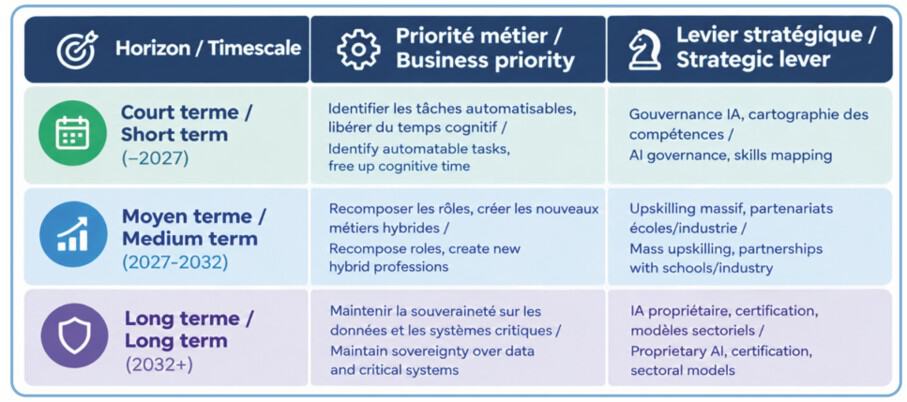
Summary: the strategic matrix
The bottom line for companies in the sector is clear: AI enhances human capability but does not replace it in high-safety environments. It is not the most technologically advanced that will succeed, but those that have managed to build a culture of continuous adaptation, with staff capable of challenging the machine just as much as it challenges them, and also capable of anticipating the challenges relating to certification.