
By Nicolas Jeuland, Emeritus Expert on the Environmental Impact of Aviation and Future Fuels, Safran, AAE correspondent (lecture in french)
The aviation industry is committed to carbon neutrality by 2050. To achieve this, the aviation industry is working on 3 main levers: the constant improvement of the fleet’s energy efficiency, in particular through the development of ultra-efficient aircraft, the optimization of operations (in flight, but also on the ground) and the substitution of fossil fuels by low-carbon solutions. In the latter category, SAFs (Sustainable Aviation Fuels) or CADs (Sustainable Aviation Fuels) have a crucial role to play as they enable an immediate decarbonisation of existing and future fleets. This conference aims to take stock of these fuels (types, resources used, production processes). In particular, the development will be discussed, highlighting the potential of these sectors, but also their limits (availability of the resource, cost). Finally, the mechanisms to support the development of these sectors will be discussed.
[Crédit image] ©Safran
Free registration required before September 11, 2024
Registrations are closed.
Conference organized as part of the National Engineering Days 2024 (JNI)
In partnership with:
 |
 |
AQUI-IHEDN is associated with this series of conferences
 |
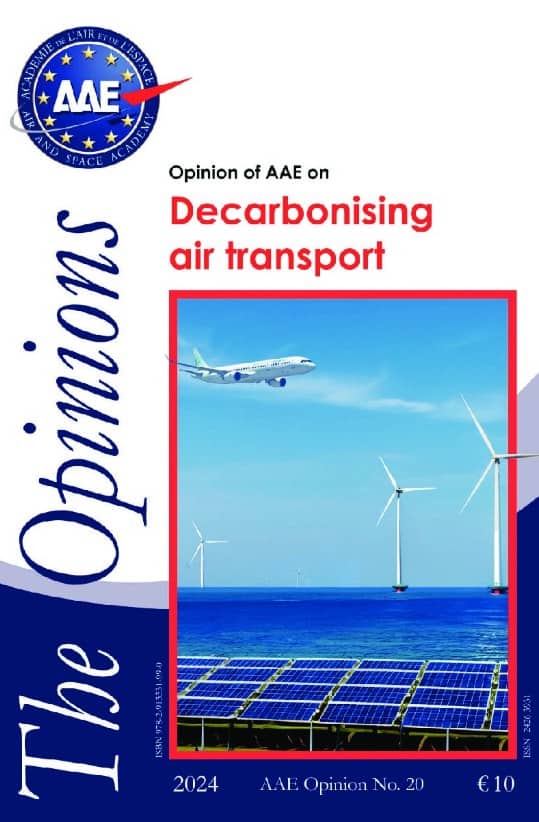
New publication!
Avis N°20 : Vers un transport aérien décarboné
Le transport aérien est mondial : il a permis un incroyable essor des relations entre les peuples. Il entend être durable face au défi climatique et vise la neutralité carbone en 2050.
Decarbonising aviation involves 4 levers: (a) a sharp reduction in aircraft fuel consumption; (b) the use of alternative fuels to kerosene; (c) carbon capture and storage to “neutralise” emissions from the remaining fossil kerosene; (d) sobriety… Read More
Available as a book (10€) or as a PDF (free download)