
Opinion No. 22 – Combat Helicopters: What aerial combat system for 2050?
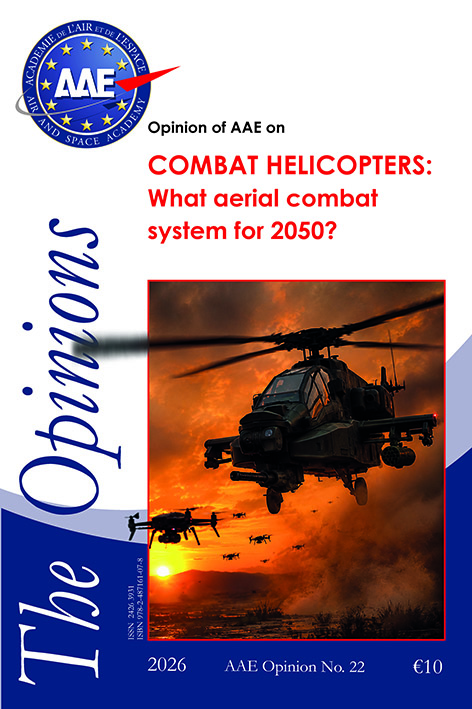
Given the resurgence of high-intensity conflicts on the European continent and the lessons learnt from the war in Ukraine, an AAE working group undertook a review of the future of combat helicopters looking ahead to 2050. The conclusions of this work, published in this Opinion, go beyond the mere question of replacing current fleets: they outline the contours of a genuine, new-generation European air combat system.
The analysis is based on a simple observation. Europe’s main attack helicopters will reach the end of their service life around 2050. Given the time required to launch and carry out a major defence programme, key decisions must be taken now.
Changes to the battlefield necessitate a fundamental transformation of operational concepts. The widespread use of drones, the increasing transparency of the theatre of operations, the acceleration of the intelligence-to-fire loop and the densification of ground-to-air defences are altering the conditions of engagement. The combat helicopter nevertheless retains key advantages: mobility, responsiveness, the ability to operate deep within enemy lines, and the capacity to rapidly shift the balance of power in favour of ground forces.
AAE therefore recommends developing not simply a successor to current aircraft, but an integrated air combat system combining manned helicopters, support drones and collaborative combat capabilities. The drones, mass-produced at low cost and equipped with modular payloads, will be required to carry out a variety of missions, including intelligence gathering, jamming, communications relay, decoy operations and strikes. They will operate in close cooperation with manned helicopters, whose continued use is considered essential for complex deep-penetration destruction missions and to ensure human decision-making capability in the use of force.
The success of such a programme depends on closer European cooperation. Harmonising operational requirements, technical specifications and support arrangements therefore appears essential to keep costs under control and preserve European industrial expertise.
It is now a matter of urgency for European nations to embark on this joint review to ensure that, by 2050, they will have a sovereign, high-performance, adaptable and sustainable air combat system.
Book version
10,00 €
Digital version
Free download
Additional information
| Weight | 120 g |
|---|---|
| Dimensions | 24 × 16 × 0,3 cm |
| Year | 2026 |
| Language | French & English (full translation) |
| Type | Book (Paperback) |
| Pages | 52 |